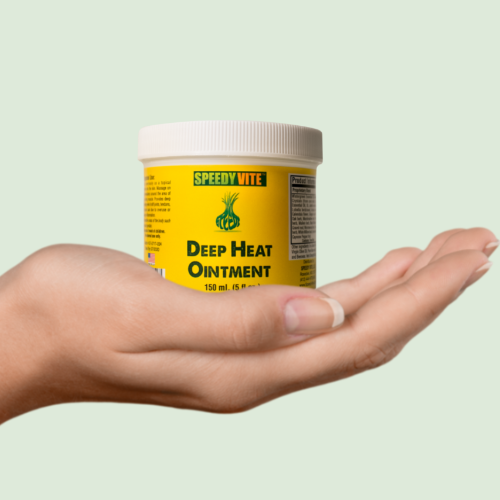
SpeedyVite® Deep Heat - Natural Muscle Ointment*
A warming herbal ointment crafted with organic and wildcrafted botanicals, designed for sore, overworked muscles and joints. Apply directly to the neck, shoulders, back, arms, or legs for a familiar warming sensation that keeps working.*
Organic & Wildcrafted
Made in USA
GMP Compliant
Beeswax + Olive Oil Base
BPA-Free Tub
Free Shipping
Where People Use It Most
Neck & ShouldersAfter long hours at a desk or on your feet, great for end-of-day tightness.*
Back & Lower BackMassage into the lower back after lifting or extended activity.*
Legs & KneesPost-workout or after a long walk, supports muscle comfort.*
Arms & ForearmsFor those who work with their hands, targeted relief where you need it.*
"Both my husband and I use Deep Heat for all kinds of pain. It helps if you lift something heavy, quickly turn the wrong way, or have back issues. The warmth is so comforting it can even help to put you to sleep."
- Linda S., verified customer
How to Use
Apply a generous amount directly to the target area. Massage in and around the sore or tight spot using firm, circular strokes. For best results, apply after a warm shower or light warm-up activity. The warming sensation typically builds within a few minutes and continues for hours.*
Tip: Pairs well with gentle stretching and hydration as part of your everyday recovery routine.*
"I use this salve frequently. It provides very effective relief for achy muscles, tendons, and joints. A little goes a long way, so only a thin application is needed. Applied right before bed, it works overnight to keep me comfortable so I'm not achy first thing in the morning. It's a high quality herbal formulation at a very reasonable price."
- Gina B., verified customer
The Herbs Behind Deep Heat
We use organic and wildcrafted botanicals with long histories of traditional use in topical rubs and liniments.*
Menthol & Wintergreen Essential OilThe classic warming and cooling pair, provides the familiar sensation of a quality muscle rub.*
Arnica FlowerTraditionally used after ordinary physical exertion, a go-to botanical for post-activity routines.*
Cayenne Pepper & Ginger RootWarming spices included for their traditional role in circulation-focused massage on tight areas.*
Birch & White Willow BarkBark herbs historically featured in rubs and liniments used around overworked muscles.*
St. John's Wort & CalendulaGentle botanicals commonly used in topical blends to support everyday comfort.*
Plantain, Marshmallow & MulleinTraditional herbs that round out the blend and contribute to a smooth, even glide.*
"The deep heat pain relief is absolutely great. Better than anything I have ever used."
- Margie L., verified customer
Full Ingredient List
Active botanicals (organic, wildcrafted & consciously cultivated):
Wintergreen Essential Oil, Menthol Crystals, Birch Essential Oil, St. John's Wort tops, Lobelia herb/seed, Arnica flower, Calendula flower, Ginger root, White Oak bark, Marshmallow root, Plantain herb, Mullein herb, Black Walnut hull, Gravel root, Wormwood herb, Skullcap herb, White Willow bark, Horsetail herb, Cayenne Pepper fruit.
Base: Extra Virgin Olive Oil, Pure Aloe Vera Oil, Beeswax.
Allergen notice: Contains tree nuts (Black Walnut hull). For external use only.
Quality You Can Feel Good About
🌿Organic & Wildcrafted
🇺🇸Made in USA
✓GMP-Compliant
🫙BPA-Free Tub
🚚Free Shipping
💚30-Day Promise
A Complementary Internal Approach
Deep Heat works from the outside in. For those looking to support the body from the inside as well, rooibos is a caffeine-free herbal tea naturally rich in antioxidants, a gentle daily complement to an active recovery routine.*
Frequently Asked Questions
What does Deep Heat feel like when applied?
The warming sensation typically builds within a few minutes. Menthol and wintergreen create the familiar warming and cooling effect, while cayenne and ginger add gentle heat that can continue for hours. It is not a harsh or instant burn, it builds gradually.*
How is Deep Heat different from a standard muscle rub?
Most commercial muscle rubs use a short list of synthetic ingredients. Deep Heat is built on a base of Extra Virgin Olive Oil, Pure Aloe Vera Oil, and Beeswax, with 19 organic and wildcrafted botanicals. The texture is a true ointment/balm, not a runny lotion, which allows for targeted, even massage.*
Can I use it every day?
We recommend applying as needed. Many customers use it after physical activity, at the end of a workday, or as part of a nightly wind-down routine. Discontinue use if any irritation occurs and consult your doctor if you have sensitive skin or an underlying condition.
Is this safe for people with nut allergies?
Deep Heat contains Black Walnut hull, which is a tree nut. If you have a tree nut allergy, do not use this product without first consulting your healthcare provider.
How long does a tub last?
Because it is a concentrated balm rather than a thin lotion, a little goes a long way. Most customers find a tub lasts several weeks to a couple of months, depending on frequency of use.
Can I use this alongside an internal approach like rooibos tea?
Yes. Deep Heat is applied topically for targeted, localized comfort, while Rooibos Tea or Rooibos Matcha offer a gentle, caffeine-free, antioxidant-rich daily habit from the inside. Many customers pair a topical routine with a daily internal habit as part of overall recovery support.*
*These statements have not been evaluated by the Food and Drug Administration. This product is not intended to diagnose, treat, cure, or prevent any disease. For external use only. Avoid contact with eyes and mucous membranes. Wash hands after use. Discontinue use immediately if any allergic or other adverse reaction occurs. Do not use past the expiration date. Keep out of reach of children.


